What Bedtime Stories Do to Your Child's Brain
The science of reading aloud: what brain scans, a million word gap and a 14 night study reveal about how the bedtime story builds your child's mind.
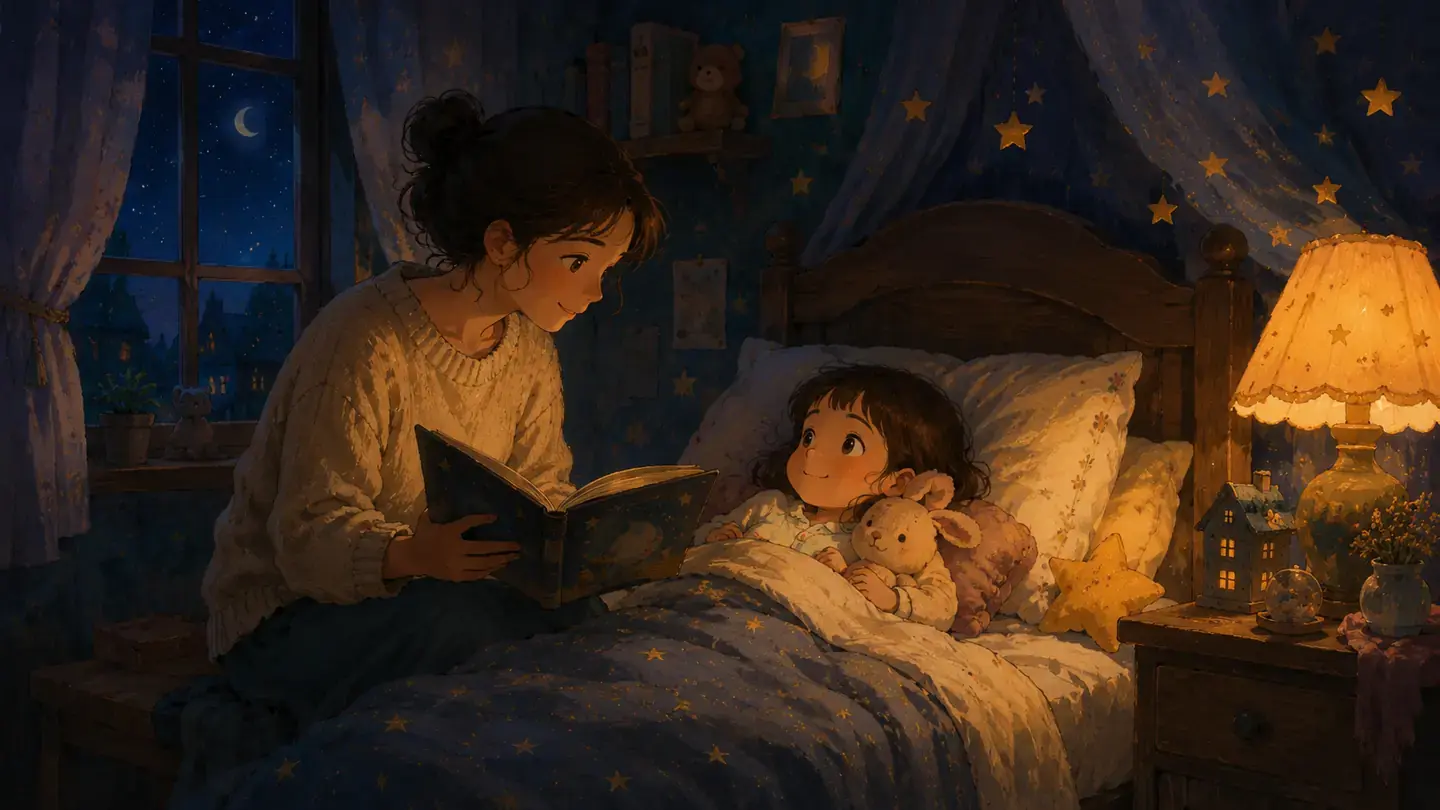
The lights are low. You open the book, find the page, and begin to read. To you it looks like the calmest moment of the day. Inside your child's head, it is one of the busiest.
The brain that sees the story
When a child listens to a story, scientists can watch the brain light up. Using MRI scanners, Dr. John Hutton and his team at Cincinnati Children's Hospital found that the regions tied to mental imagery switch on, the parts that let a child see a dragon, a forest, a grandmother's kitchen, far beyond whatever is printed on the page. The children who were read to most at home showed the strongest activation there, and built sturdier wiring for imagination and, later, for reading itself. The story does not stay on the paper. It helps wire a brain.

A million words before kindergarten
Then there are the words. A 2019 Ohio State study did the arithmetic on how many words a child hears from books before turning five. A child read to every day hears about 290,000 more words than a child who is never read to. Read five short books a day, and the gap climbs to 1.4 million. These are not everyday words like cup and shoe. Books are where children first meet shimmer, ancient, curious and brave. A nightly story is a vocabulary, quietly stacking up.
Not too cold, not too hot
Not every story feeds the brain the same way. In a clever experiment, Hutton showed young children the same tale in three formats and watched their brain networks respond. Audio alone was too cold: the language regions strained with no pictures to lean on. A fast cartoon was too hot: the screen did all the work, and the different parts of the brain barely spoke to each other. The just right zone was a narrated story with illustrations, words and pictures together, leaving just enough room for a child's own imagination to fill in the rest. Gentle, narrated, illustrated. It is the quiet opposite of a frantic screen.
It does not only make them smarter, it makes them kinder
Stories also teach children how other people feel. In a 2026 study published in PLOS ONE, young children who read a storybook for just 14 nights showed measurable gains in empathy, whether or not the grown-up paused to ask questions. It fits a broad consensus: the American Academy of Pediatrics, in its 2024 literacy guidance, ties reading aloud to social and emotional development, resilience, and warm parent and child bonds. Part of that is the words. Part of it is the warmth: a trusted adult, a quiet room, full attention. A brain learns best when it feels safe.
The quiet handoff into sleep
There is a reason this works at bedtime in particular. A calm, predictable story lowers the temperature of the day and tells the body that sleep is near. As your child drifts off, the sleeping brain gets to work, filing away what it met that evening, the new words and the new ideas, into longer term memory. Winding down and wiring up turn out to be the same thing.

Why we built Dreamtime this way
This is the science we kept returning to while making Dreamtime Stories: gentle narration, soft storybook illustrations and read along text, a story built to spark a child's imagination rather than hijack their attention. A few of our tales even explore the very thing happening under the pillow: how the mind works, in Your Brain, the Most Complex Thing You Carry, and why we dream, in Sleep and Dreams, both part of our calm science stories about the human body.
So tonight, when you reach for the bedtime story, know that it is doing far more than ending the day. It is building a mind, one calm and wonderful word at a time.
Sources
- Hutton et al., home reading and brain activation in preschoolers (Pediatrics, 2015)
- Hutton et al., the Goldilocks effect, story format and brain connectivity (2018)
- Logan et al., Ohio State, the million word gap (J. Dev. Behav. Pediatrics, 2019)
- Clabough et al., reading and children's empathy, 14 bedtimes (PLOS ONE, 2026)
- American Academy of Pediatrics, Literacy Promotion policy statement (Pediatrics, 2024)