Why the Northern Lights Dance
The real science of the northern lights: how the Sun, Earth's magnetic shield and the air itself paint the night sky green, told warmly for parents.
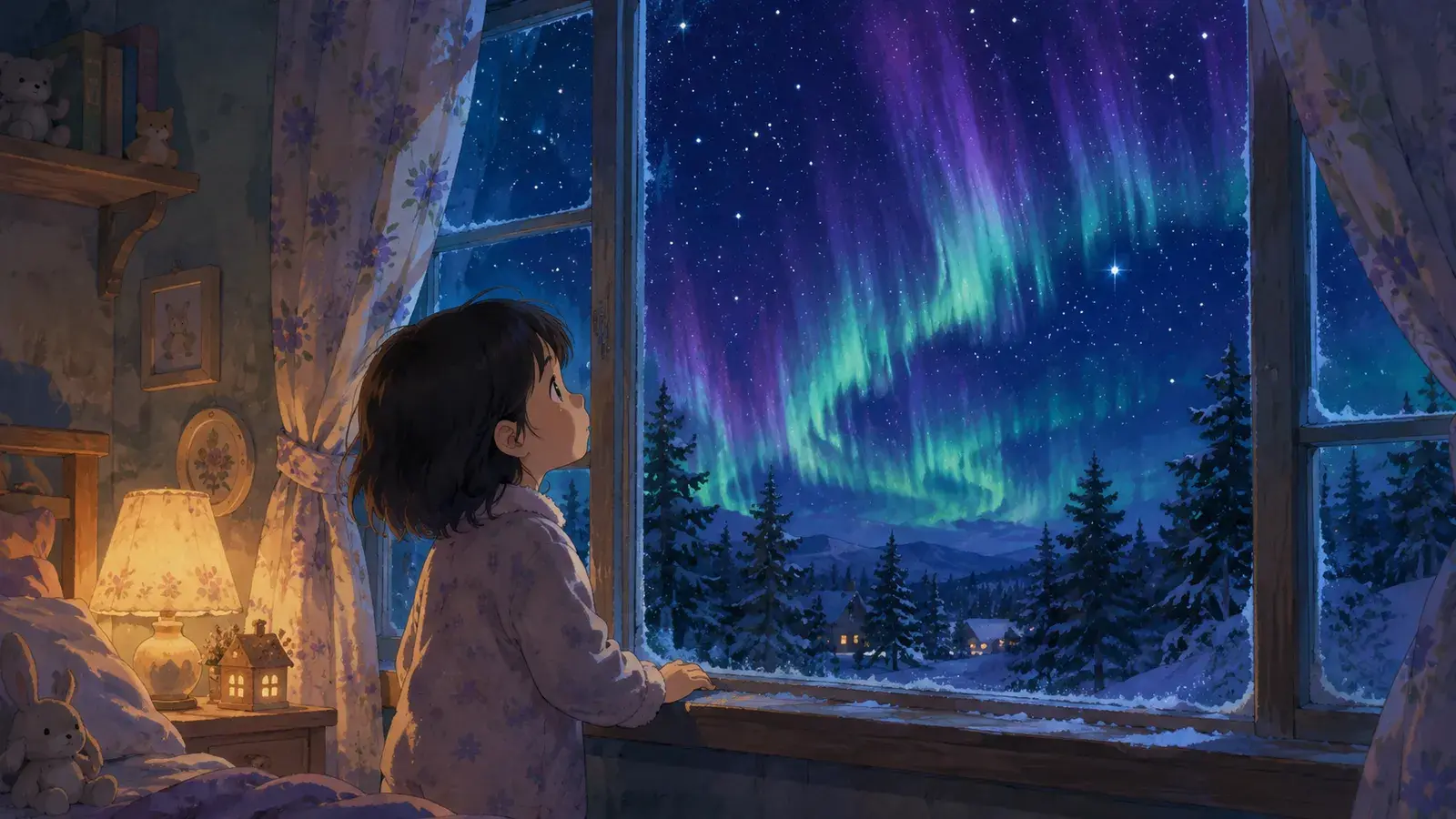
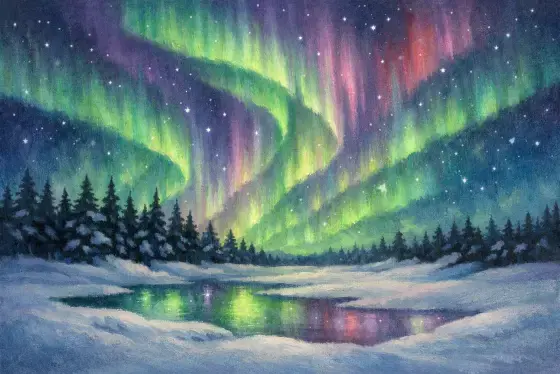
Far from any city, on a cold and cloudless night, a child looks up and the sky begins to move. A ribbon of green light appears where a moment ago there was only black, brightens, and then ripples across the stars like a curtain caught in a slow wind. Nothing is burning. No lamp has been switched on. The sky itself has started to glow.
These are the northern lights, the aurora, and they are not magic, however much they look it. They are the very top of our air, lit up by the Sun, some sixty miles above the ground. Here is what is really happening up there, from the moment the wind leaves the Sun to the moment the sky lights up over your child's head.
It starts on the Sun
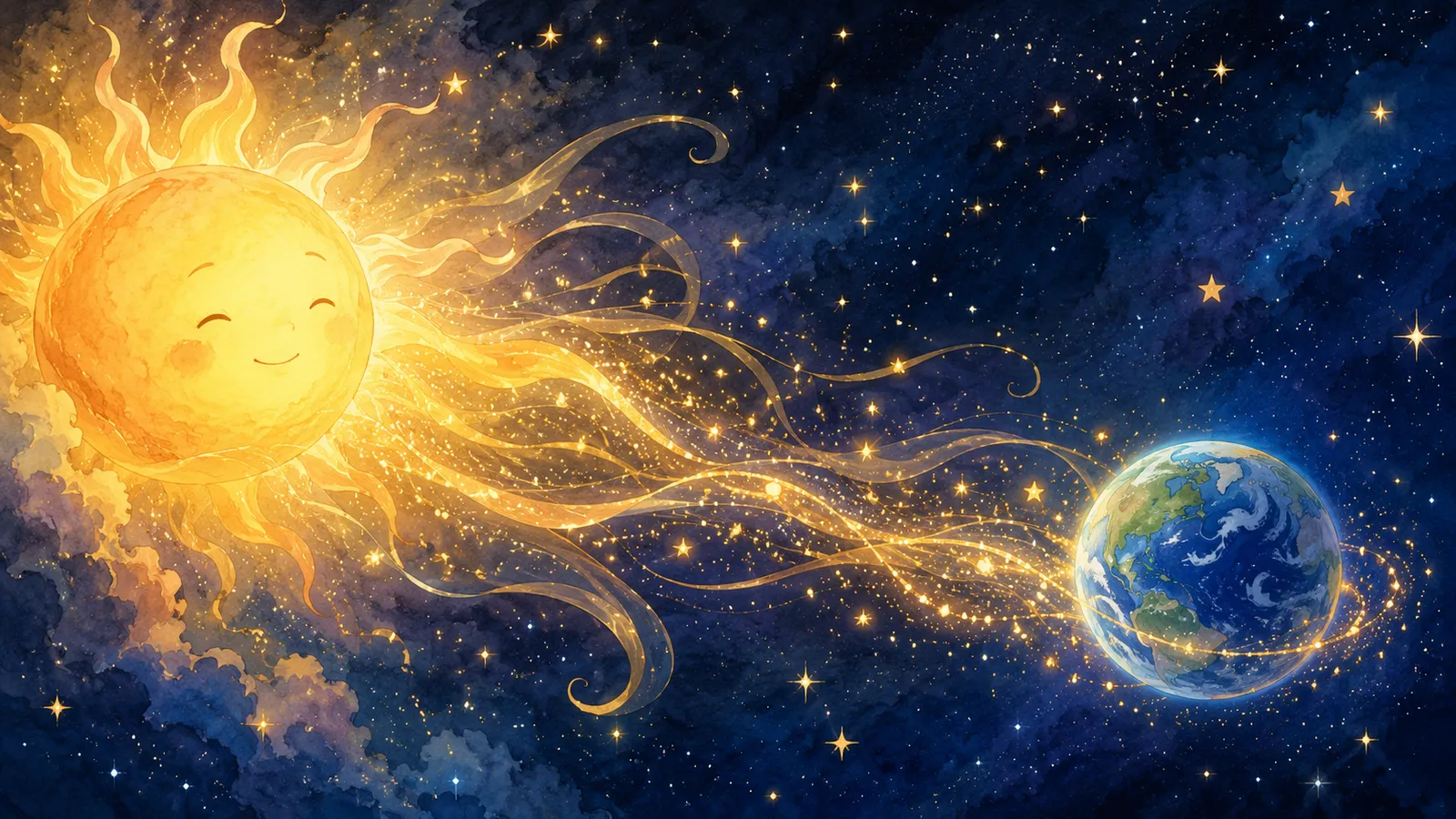
Our Sun looks steady, but it is anything but calm. It is always blowing a stream of tiny charged particles out into space, a breeze that never stops, which scientists call the solar wind. NASA clocks it moving at close to a million miles an hour, and even at that speed it takes a couple of days to cross the long gap to Earth.
Most nights that wind simply flows past us. But when the Sun is stormy and the wind blows hard, far more of those particles come our way, and the sky gets its chance to dance. The Sun that sends them is really a star, the nearest one to us, and stars have long and dramatic lives of their own, which your child can follow in How Stars Are Born and Die.
Earth catches it with an invisible shield
Earth is not defenseless. Deep inside, our planet's spinning core turns the whole world into a giant magnet, wrapping it in an invisible magnetic shield. NASA scientists note that this shield does an important job: it turns away most of the solar wind and helps protect the life sheltering beneath it.
But the shield is not a solid wall. Near the top and bottom of the planet it dips inward, toward the two poles, and there it funnels some of the arriving particles down into the air. That is why the lights are not scattered everywhere but gather into great glowing rings around the poles: the aurora borealis in the far north and the aurora australis in the far south, often shining at the very same time.
Where the colors come from
Now for the light itself. Sixty to two hundred miles up, far above any cloud, the incoming particles crash into the thin gases of the upper air, and each gas answers with its own color. Strike oxygen, and it glows green, or, higher still, a deep ruby red. Strike nitrogen, and it glows blue and violet. Each atom soaks up the energy of a collision, holds it for a heartbeat, then hands it back as a small flash of colored light, over and over, millions of times at once, until a whole sky is painted.
It is one of the largest and gentlest light shows in nature, and your child can watch the whole thing unfold, slowly and calmly, in Why the Sky Dances.
Why it ripples like a curtain
The strangest part is the movement. The aurora never sits still. It hangs in folds and ribbons and slowly waves, as if a giant hand were shaking out a sheet of light. Those folds are tracing something no eye can see. The glowing particles follow the invisible lines of Earth's magnetic field, and as that field trembles and shifts under the push of the solar wind, the curtains of light shift with it. When we watch the aurora dance, we are really watching the shape of a magnetic field, made visible for a few minutes by the glowing air.
Earth is not the only world that glows
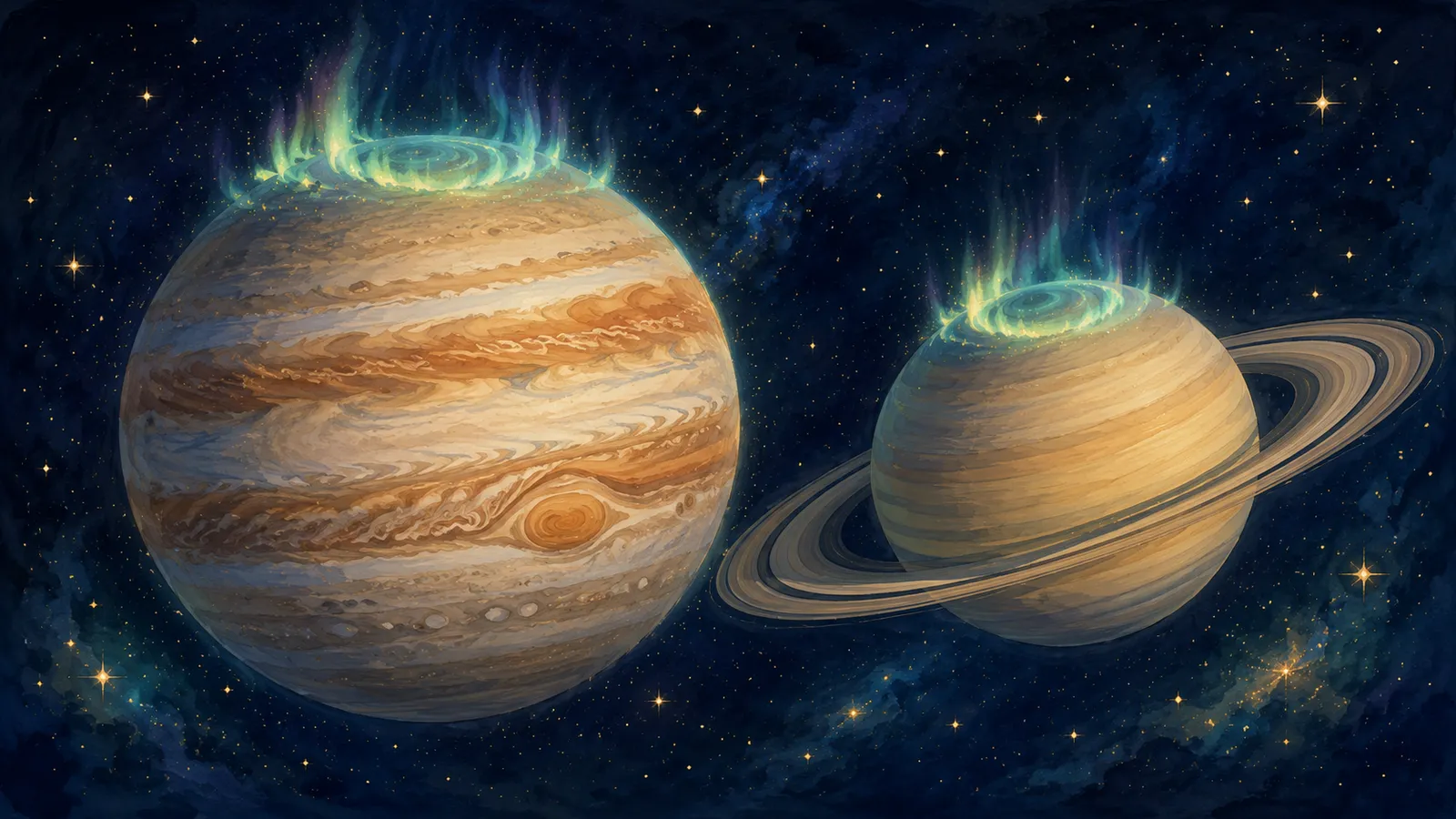
Earth is not even the best at this. Auroras appear on other planets too, wherever a world has both a magnetic field and an atmosphere for the particles to strike. Jupiter's magnetism is about twenty thousand times stronger than ours, and the Hubble Space Telescope has photographed brilliant ovals of light burning at its poles. Saturn wears shimmering crowns of aurora that tower hundreds of miles above its clouds. Even Mars glows in patches. Our planet's quiet green ribbons are one small part of a light show that plays right across the solar system.
A sky worth looking up at
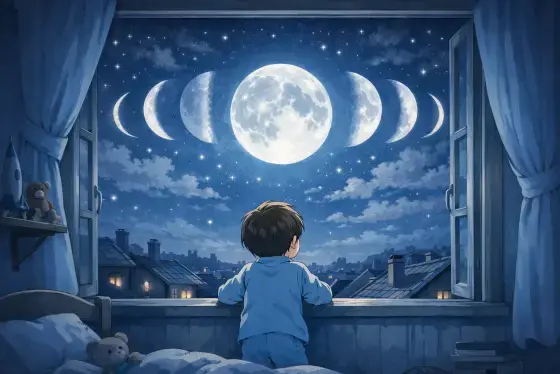
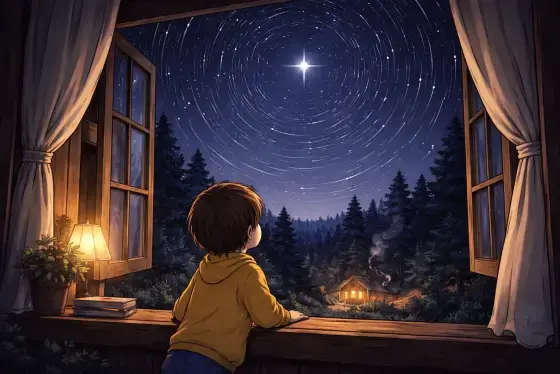
Most children will never stand beneath an aurora, but every child can look up. The same night sky that dances at the poles holds slower wonders that anyone can find from a bedroom window: a moon that quietly changes its shape from one night to the next, in The Moon Changes Shape, and one steady star that always points the way home, in The North Star.
Every Dreamtime story takes one true wonder like this and tells it gently, narrated and illustrated, calm enough for the end of the day. So the next time your child asks how the sky can glow in the dark, you can answer with a story, and let them drift off a little more amazed by the world above them.
Sources
- NASA Science, Auroras: the solar wind, charged particles and how they rain into the atmosphere
- NASA Space Place, What Is an Aurora? (particles from the Sun; colors come from the gases in the air)
- NASA, Fast Solar Wind Causes Aurora Light Shows (solar wind speed)
- NASA Earth Observatory, Aurora Australis (green oxygen near 100 km; colors by altitude)
- NASA Astrobiology, The Northern Lights, the Magnetic Field and Life (Earth's magnetic shield)
- NASA / Hubble, Vivid Auroras in Jupiter's Atmosphere (Jupiter's magnetism about 20,000 times Earth's)
- NASA, Saturn's Colorful Aurora (auroras towering high above the planet)